Key takeaways
- Two separate systems: VA holds records from VA facility treatment; NPRC holds military service treatment records (STRs), the OMPF, and the DD-214. Each requires a separate request.
- Separation date controls custody: Veterans separated 62 or more years ago have archival records handled by NARA through NPRC; more recent records may remain with DoD or VA.
- Forms matter by requester type: Use VA Form 10-5345a for your own VA health records, VA Form 21-4142 to authorize VA to gather private provider records, and SF-180 or eVetRecs for military records.
- Authorization requirements differ: Family relationship alone is not sufficient for third-party access to a living veteran’s records; written authorization, power of attorney, or court documents are required.
- Escalation has a deadline: FOIA appeals must be filed in writing within 90 days of a denial.
Veterans medical records retrieval means working with two distinct federal systems: the Department of Veterans Affairs (VA) for health records from VA facilities, and the National Personnel Records Center (NPRC) for military service treatment records and personnel files. The right agency, the right form, and proper authorization determine how quickly you get what you need. Missing any one of those three elements is a common reason requests stall for weeks.
This guide covers every step of that process. You’ll learn where each type of record lives, which form or portal to use, what documentation is required depending on who is making the request, what timelines and fees to expect, and how to escalate when a request stalls.
Whether you’re a veteran, a family member, or a legal advocate preparing a VA disability claim or appeal, this is the step-by-step reference you can follow from first request to final delivery.
Veterans medical records retrieval: Which agency holds your records?
The answer depends on what you need and when the veteran separated from service. The VA holds records from treatment received at VA health-care facilities. NPRC, operated by the National Archives (NARA), holds the Official Military Personnel File (OMPF), including the DD-214, assignments, awards, evaluations, and many military service treatment records. These two systems are entirely separate and require separate requests.
Separation date plays a significant role in determining which system controls the file. For veterans separated less than 62 years ago, records are generally still under DoD or VA control, though NPRC may hold many transferred files, according to the National Archives. For veterans separated 62 or more years ago, the OMPF is considered archival and handled by NARA through NPRC, according to the National Archives.
Use this decision framework before submitting anything. If the veteran received VA treatment, contact the treating VA facility’s Release of Information (ROI) office at the treating VA facility. If you need a DD-214, OMPF, or STRs, use eVetRecs or SF-180 to submit to NPRC. If a VA disability claim is already filed, contact VA first, since VA can retrieve military health records from DoD or NPRC directly under its duty-to-assist obligation (38 CFR 3.159).
Inpatient clinical records may also be filed separately from outpatient service treatment records. A veteran who received hospital care during service may have that inpatient file at the original military treatment facility or retired to NPRC independently. Request both explicitly when both are relevant to the claim.
Veterans medical records retrieval: Forms and portals for VA health records
The correct form depends on who is making the request and what the records will be used for.
| Requester or purpose | Form or portal | Where to submit |
|---|---|---|
| Veteran requesting their own VA health records | VA Form 10-5345a | ROI/Health Information Management office at the treating VA facility, by mail, fax, or in person with valid photo ID |
| Attorney, insurer, or other authorized third party | VA Form 10-5345 | ROI office at the facility holding the records; documented veteran authorization required |
| Veteran accessing records electronically | My HealtheVet | Sign in through VA.gov to review, print, and download available records |
| Veteran requesting via VA messaging | Secure Messaging (VA.gov) | Send to a care team with “Release of Information” in its name; VA acknowledges within three business days per VA guidance |
| VA disability claim requiring private provider records | VA Form 21-4142 (with 21-4142a) | Online through the VA claims process or by mail |
Forms 10-5345a and 10-5345 release records held by a VA health-care facility only. They are not used to authorize VA to obtain records from outside providers. That function belongs to Form 21-4142, which covers private or non-VA provider records needed for a disability claim.
A detail that catches many representatives off guard: the veteran must personally sign VA Form 21-4142. An accredited attorney or claims agent may prepare and submit the form but cannot sign it on the veteran’s behalf. The exception is a separately held legal authority, such as a durable power of attorney or court appointment, that explicitly permits signing that specific document. Have the veteran sign Forms 21-4142 and 21-4142a directly; the authorization is generally valid for 12 months from the signing date, according to VA.
How do you request military service treatment records?
Two routes lead to the same destination at NPRC: the online eVetRecs system and the paper SF-180. NARA’s eVetRecs system accepts online requests for military personnel and medical records. It generates a request form that you print, sign, and return, making it the faster starting point for most requesters. Standard Form 180 is the paper alternative, accepted by mail and by fax to NPRC at 314-801-9195, according to the National Archives.
For any NPRC request, include the veteran’s full name as used in service, Social Security number or service number, branch of service, dates of service, date and place of birth, the type of records requested, and your relationship to the veteran. For medical records, be specific: “complete service treatment record,” “inpatient clinical records from [facility name and dates],” and “outpatient dental records” are different requests that may be held in different locations. Most NPRC requests go to National Personnel Records Center, 1 Archives Drive, St. Louis, MO 63138.
Allow about 10 days for NPRC to receive and begin processing before checking status, according to the National Archives. NARA advises against sending a follow-up for at least 90 days, because duplicate requests can slow processing further. Standard requests for veterans or eligible next of kin carry no fee for basic non-archival records. For archival records covering veterans separated 62 or more years ago, the National Archives charges $25 for an OMPF of five pages or fewer and $70 for six pages or more.
What authorization and documentation does each type of requester need?
Living veterans requesting their own records need a signed, written request with full name, date of birth, Social Security number or VA file number, current address, and a description of the records needed. For in-person submission at a VA ROI office, valid photo ID is required.
Third parties acting on behalf of a living veteran face a higher standard. Family relationship alone is not sufficient. VA requires the veteran’s written authorization, signed and dated, identifying the authorized person and describing the records covered. Acceptable proof of authority includes a VA release form signed by the veteran, a valid power of attorney, or court appointment documents such as guardianship or conservatorship papers.
For a deceased veteran, the Privacy Act no longer applies, but VA and HIPAA-related rules still restrict access to certain records. Eligible next of kin (an unremarried spouse, children, parents, or siblings), executors, and legally authorized estate representatives may request records. A complete submission typically includes a signed request, the veteran’s identifying information, proof of death (a death certificate, obituary, or coroner’s report), and proof of relationship or legal authority.
An additional layer applies to specific record categories: substance-use-disorder treatment records, HIV-related information, and sickle-cell anemia records carry heightened protections under 38 U.S.C. § 7332 and require specific consent even when other medical records can be released.
What do you do when a request stalls or gets denied?
Most delays trace back to a small set of fixable problems: a missing signature, inadequate identity verification, an unclear description of the records sought, or a request routed to the wrong VA facility. For older files, timing is a factor too. Most VA health-record requests complete within 30 days, but pre-1998 records stored offsite can take up to 90 days, according to VA News.
When a request is overdue, start with the ROI office at the treating facility. Ask for a tracking number, the assigned contact, and confirmation of receipt. If that doesn’t move things forward, escalate to the ROI supervisor or facility Privacy Officer. VHA Directive 1605.01 sets a target of 20 business days for responding to, or at minimum acknowledging, requests for individually identifiable information.
For personal records, identify your request specifically as a Privacy Act right-of-access request rather than a standard FOIA request. VA notes that routing a personal records request through FOIA can slow processing. Use FOIA for agency operational records or records the ROI process cannot produce through normal channels.
If VA denies access in whole or in part, appeal in writing within 90 days of the denial, according to VA’s FOIA FAQ. FOIA appeals go to the VA Office of General Counsel at ogcfoiaappeals@va.gov, or by mail to the address specified in the denial notice. A records-access dispute is separate from a benefits decision appeal. If VA decided a claim without obtaining relevant records, use the appropriate benefits review lane (Supplemental Claim, Higher-Level Review, or Board Appeal) and identify the missing records as a duty-to-assist error.
When professional retrieval support makes the difference in a VA claim
A VA disability claim or appeal typically requires two parallel streams of records: military service treatment records from NPRC and private civilian treatment records from hospitals, clinics, or specialists. Each stream involves different agencies, forms, timelines, and authorization requirements. Managing both while monitoring an active claim creates real administrative burden for legal teams working multiple cases simultaneously.
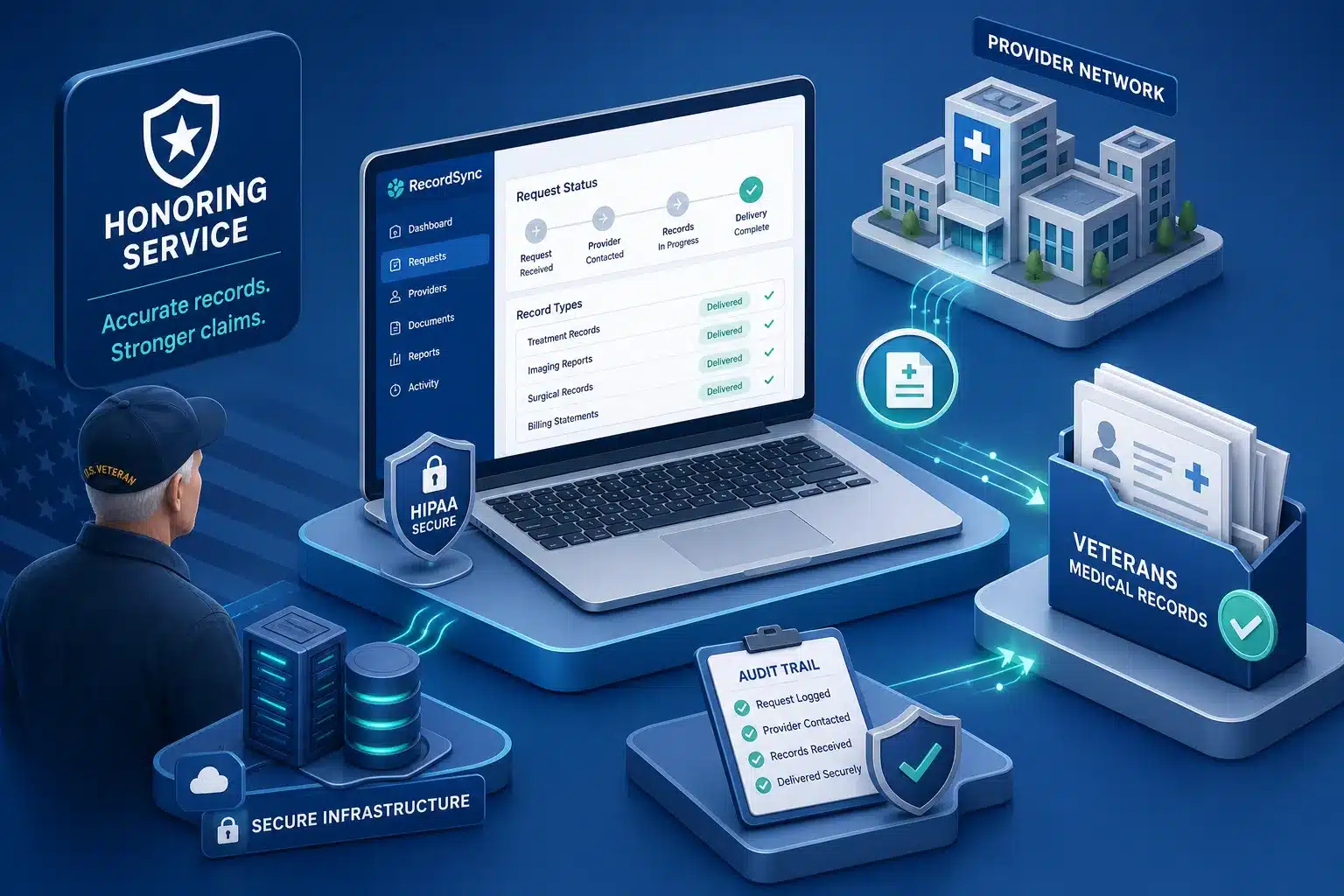
For veterans’ benefits attorneys and advocates, retrieving veterans’ medical records is not a one-time task. Building a complete evidentiary record for the VA requires persistent provider outreach, careful authorization management, and consistent follow-up until every file arrives. Record Retrieval Solutions (RRS) has experience retrieving both military and civilian medical records to support VA disability claims and appeals. RRS manages the full retrieval cycle, from provider outreach and authorization management to follow-up and certified delivery, so legal teams stay focused on the claim rather than the paperwork pipeline. Their HIPAA-compliant platform, RecordSync, centralizes requests and keeps every status update visible in real time, reducing reliance on emails and spreadsheets.
Putting it all together
Effective veterans medical records retrieval depends on knowing which federal custodian holds the record you need, submitting the correct form with complete authorization, and following up strategically when the process slows. Use VA Form 10-5345a for your own VA health records, SF-180 or eVetRecs for military service treatment records, and VA Form 21-4142 to authorize VA to gather private provider records for a disability claim.
When a VA disability claim or appeal is on the line, incomplete or delayed records can cost a veteran months or years of benefits. Every request needs to be specific, documented, and followed through to delivery. Vague requests and duplicate submissions are the two fastest ways to extend an already long timeline.
For legal teams handling veteran medical record retrieval at scale, working with an experienced retrieval partner can close records gaps faster and keep appeals moving forward.
Contact RRS to learn how the team supports veterans’ benefits attorneys and advocates nationwide.
FAQs
How long does a veteran's authorization on Form 21-4142 remain valid?
The veteran’s signature on Forms 21-4142 and 21-4142a is generally valid for 12 months from the signing date. An accredited attorney or claims agent may prepare and submit the form but cannot sign it for the veteran unless a separate legal authority explicitly permits that signature.
Will the VA obtain military treatment records for a pending disability claim, or do we have to request them from NPRC ourselves?
The VA can retrieve military health records from DoD or NPRC directly under its duty-to-assist obligation when a VA disability claim is filed. You should still use NPRC routes if you need specific STRs or an OMPF directly, but contact VA first when a claim is already pending.
Are there fees for requesting records from NPRC, and when do fees apply?
Standard requests for veterans or eligible next of kin for non-archival military records generally carry no fee. For archival records covering veterans separated 62 or more years ago, NARA charges $25 for an OMPF of five pages or fewer and $70 for six pages or more.