Key takeaways
- Start retrieval at intake: Identify every claimant’s provider history and authorizations at intake, not weeks after case acceptance.
- Centralize vendor visibility: Scattered email and spreadsheet tracking fails at mass tort volume. A single platform tracking every request, follow-up, and delivery is non-negotiable.
- Standardize your file structure: Uniform naming conventions and consistent tagging let any team member locate records without relying on institutional knowledge.
- Build escalation rules early: For individual-access requests, HIPAA gives covered entities up to 30 days to respond, with one possible extension. Missed submission windows can push claimant files behind schedule regardless of which timeline governs.
- Treat QC as a formal checkpoint: Build gap analysis and completeness checks into the workflow, not as afterthoughts.
Efficient mass tort record management requires four things running simultaneously: a retrieval workflow that starts at intake, a vendor system that tracks every request to completion, a file structure that holds up across thousands of claimants, and quality controls that catch gaps before discovery deadlines arrive. Without all four, even a well-staffed firm ends up chasing records instead of building cases.
A single mass tort docket can involve thousands of claimants, each needing medical, billing, exposure, and damages records from multiple providers. The operational surface area is enormous. This guide covers the five areas that determine whether your records program holds up at scale: workflow design, vendor coordination, file organization, deadline tracking, and quality control.
What does an efficient mass tort record management workflow actually look like?
The retrieval workflow has six stages: build the provider history, collect valid authorizations, route and submit requests, track deadlines and status, follow up and cure deficiencies, then receive and organize records. The most important point is that stage one begins at intake, not after case acceptance.
Starting retrieval at intake, not after case acceptance
When a claimant’s provider history, authorization requirements, and record types are not identified during intake, the delay compounds immediately. The full record universe a mass tort demands is wide: medical records from before and after exposure, product and exposure records, financial and damages documentation, and plaintiff fact sheets. Missing even one provider at intake creates a catch-up cycle that runs straight into discovery deadlines.
How requests route across a fragmented provider landscape
A single claimant’s records can require requests to multiple separate custodians. Providers use different submission channels, including portals, fax, mail, vendor platforms, and subpoenas, and many maintain separate custodians for billing, imaging, and clinical records. For individual-access requests, HIPAA gives covered entities up to 30 days to respond, with one possible 30-day extension under limited circumstances, though attorney-authorized requests, subpoenas, and court orders operate under different timelines. A late or defective submission can significantly extend retrieval time, depending on the applicable deadline and the provider’s internal workflow.
What “complete” means before a file advances
Completeness means the relevant record types for each case, clinical records, billing, imaging, and pharmacy history where applicable, are all accounted for across the correct date ranges, with gaps documented rather than silently skipped. Incomplete provider histories often cause downstream delays, as do invalid or expired authorizations. Treating completeness as an informal check rather than a formal checkpoint is what turns a manageable docket into a growing retrieval backlog.
How do you coordinate mass tort document management across dozens of providers and claimants?
The coordination challenge is not about effort; it is about visibility. When retrieval is managed through email threads, spreadsheets, and phone follow-ups with multiple vendors, teams quickly lose track of outstanding records, unresolved fees, and expired authorizations. At mass tort volume, even a modest delay rate across a large claimant population means hundreds of stalled files, each compounding as court deadlines approach.
Passive retrieval versus full-service: what the difference costs you
Vendors that submit requests and then wait leave follow-up and escalation to whoever notices the gap first. That is a structural problem, not a staffing one, because even a diligent team cannot compensate for a workflow that never built in accountability after submission. The table below shows how the two approaches differ across the criteria that matter most at mass tort volume. The passive-vendor column reflects illustrative characteristics of a limited-service model, not any specific provider.
| Criteria | Passive retrieval vendor (illustrative) | Full-service partner (RRS) |
|---|---|---|
| Provider outreach | Submits requests only | Active outreach from submission through delivery |
| Follow-up | Manual, initiated by the firm | Persistent follow-up built into the workflow |
| Fee handling | Firm manages separately | Handled end-to-end |
| Status visibility | Email or periodic updates | Real-time via RecordSync portal |
| Certified delivery | Varies by vendor | Available upon request |
| Average turnaround | Variable | 15-day average reported |
| HIPAA compliance | Varies by vendor | HIPAA-compliant throughout |
How RecordSync centralizes visibility across your entire docket
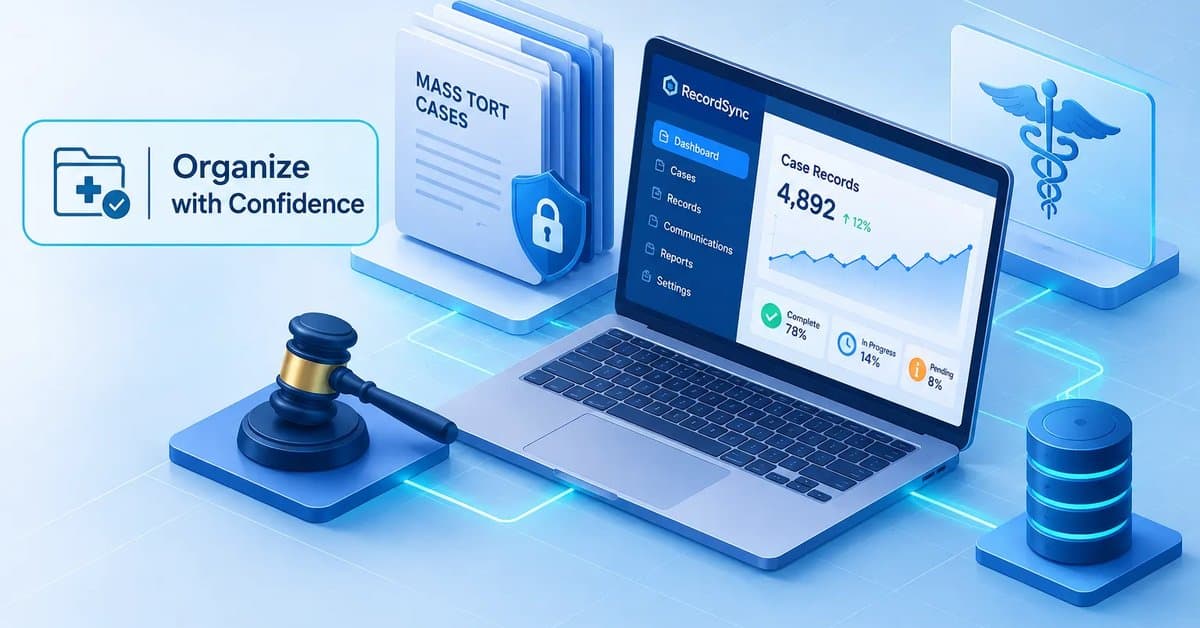
Our proprietary RecordSync platform centralizes every retrieval request, follow-up, escalation, and certified delivery in one HIPAA-compliant portal, giving your legal team real-time status across the entire docket without chasing vendors. We report a 15-day average turnaround, which matters when you are running hundreds of simultaneous requests across a mass tort docket. Our team handles provider outreach, fee management, and persistent follow-up end-to-end, so your staff stays focused on case strategy rather than record administration.
What to require from any retrieval partner at this volume
When evaluating vendors for mass tort medical record retrieval, hold every candidate to the same non-negotiables: HIPAA-compliant handling with a signed Business Associate Agreement, certified delivery capability, real-time status visibility, active escalation protocols, and demonstrated experience with high-volume dockets. A vendor that hands off requests and waits is a liability at mass-tort scale, not just an inconvenience, because every gap in their follow-up becomes a gap in your timeline.
How should mass tort files be organized to survive a large docket?
Organization at a mass tort scale is a design problem. Inconsistent naming conventions and ad hoc folder structures can become increasingly difficult to manage as a docket grows. The solution is a standardized system built before volume arrives, not after volume exposes every gap in your structure.
Building a file structure that scales without breaking
Organize records by claimant or matter ID first, then by document type and litigation phase: medical records, billing, exposure documentation, correspondence, pleadings, and settlement materials. Standardized naming conventions and consistent tagging allow staff at any level to locate records without relying on institutional knowledge. OCR processing and full-text search convert paper records and non-searchable PDFs into usable assets, which matters most when records arrive in legacy formats from older providers.
Creating medical chronologies that hold up under scrutiny
The chronology-building process follows a defined sequence: collect and inventory records, extract clinically significant events, merge entries from multiple providers into a single date-ordered timeline, and cross-reference related records to flag contradictions or documentation gaps. Standard deliverables include detailed medical chronologies, narrative summaries, case-review charts, and claimant matrices that compare populations using common fields such as exposure type, diagnosis, treatment, and causation indicators. Each entry should link back to the source record so attorneys and experts can verify facts without hunting through the underlying files, a practice widely recommended in mass tort medical record review workflows.
Separating claimant files from shared litigation resources
Claimant-specific records and the master repository of common pleadings, expert reports, discovery protocols, privilege logs, and approved templates should stay structurally separate. When firm-wide litigation strategy documents get buried in individual claimant folders, version-control problems follow immediately, and the wrong version of a template reaches opposing counsel or the court.
What’s the right way to track deadlines without letting claims fall through?
Mass tort deadline management is layered. Court-ordered discovery cutoffs, statute-of-limitations dates per claimant jurisdiction, MDL case management order milestones, plaintiff fact sheet submission windows, and internal follow-up intervals for outstanding record requests all run simultaneously. Any one of them, missed across a cohort, produces cascading delays.
Building escalation triggers before deadlines arrive
Set internal escalation thresholds before a deadline becomes urgent. If a request has not received a response confirmation within 10 days, it should move to active follow-up status; at 20 days, it escalates to a senior coordinator or vendor account manager. Dashboard-level visibility showing every outstanding request sorted by age, claimant, provider, and deadline proximity is the operational minimum for any substantial docket. When escalation and follow-up run through a centralized platform rather than individual email inboxes, the risk of a missed task drops significantly, a request no longer falls through because one coordinator is out or a vendor message goes to the wrong folder. Backup ownership rules and automated alerts provide an additional layer of accountability.
What quality controls catch errors before they reach the courtroom?
QC in mass tort medical record review is not a final pass. It is a formal checkpoint built into the workflow at every hand-off, from retrieval through chronology to production. In practice, that means each stage produces a documented output that the next stage verifies before the file advances, not a cursory scan, but a structured review against a defined checklist.
Completeness checks and gap analysis as a formal step
A QC checklist for each file should confirm that all requested record types arrived (clinical, billing, imaging, pharmacy), verify that date ranges match the claimant’s treatment history, flag duplicate records, and document missing materials with an explanation. One missed record type, such as pre-exposure pharmacy history, can undermine causation arguments for an entire claimant cohort if the same gap exists across multiple files.
HIPAA and confidentiality requirements for mass tort records
Law firms handling claimant medical records carry professional confidentiality duties under state ethics rules, and in some cases HIPAA Business Associate obligations depending on the firm’s role and the services performed. Prudent safeguards include encryption in transit and at rest, role-based access controls, multi-factor authentication, and audit logs. Business Associate Agreements are required when a vendor qualifies as a business associate under HIPAA, an analysis that depends on the parties’ roles and the nature of the services. Any retrieval partner, cloud storage provider, or e-discovery platform that touches claimant records should be vetted and contractually bound to appropriate security standards before it receives a single file.
Applying consistent review standards across multiple teams
Different teams handle intake, retrieval, review, and case management in large mass tort practices. Without calibration, the same record may be tagged differently by different reviewers, which creates inconsistencies that surface at the worst possible time, during expert preparation or depositions. Required-field reporting, exception queues for files that fail completeness checks, and periodic calibration sessions keep coding standards consistent across the entire docket. Maintaining document version history, access logs, and edit records supports operational consistency and security obligations that vary by the firm’s role, applicable law, court orders, and contracts.
Mass tort record management at scale is a system, not just a process
Efficient mass tort record management ties together workflow design, vendor coordination, file organization, deadline tracking, and quality control into one repeatable system. Volume and complexity mean any single weak point, whether a scattered vendor relationship or an informal deadline tracker, compounds across thousands of files in ways that are difficult to reverse once discovery is underway.
For firms managing mass tort dockets that cannot afford retrieval gaps, RecordSync provides the centralized visibility and scalability to track every request from submission to certified delivery. Our full-service model handles provider outreach, fee resolution, and persistent follow-up so your legal team stays focused on building cases rather than tracking down records. We serve legal teams nationwide, from solo practitioners to large enterprise litigation departments, with HIPAA-compliant handling and a reported 15-day average turnaround.
Review your current records workflow against the five areas this guide covers. If any one of them lacks a defined process and a clear owner, that is where your next delay will come from.
Contact our team to see how we can support your docket.
FAQs
What can delay a mass tort records request?
An incomplete provider history, an invalid or expired authorization, or a late or defective submission can delay your request. Separate custodians for billing, imaging, and clinical records can also complicate retrieval.
How long do providers have to respond to a records request?
For individual-access requests, HIPAA gives covered entities up to 30 days to respond, with one possible 30-day extension under limited circumstances. Attorney-authorized requests, subpoenas, and court orders operate under different timelines.
When should your team escalate an unanswered records request?
Your team should begin active follow-up if a request has no response within 10 days. At 20 days, escalate it to a senior coordinator or vendor account manager.
Why should medical chronology entries link to source records?
Source links let your attorneys and experts verify chronology entries without hunting through the underlying files. A date-ordered timeline can also help your team flag contradictions and documentation gaps.
What security safeguards should you use for claimant records?
Prudent safeguards for your claimant records include encryption in transit and at rest, role-based access controls, multi-factor authentication, and audit logs. Before a vendor receives a file, you should vet it and contractually bind it to appropriate security standards.